16 January 2018
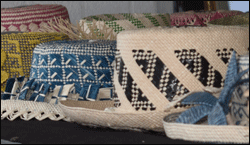 Weaving is very much part of Pacific Island cultures and I was keen to see the weaving in Rarotonga when I visited recently. I was expecting to see large market baskets and hats with circular crowns woven out of green palm leaves but these were very scarce. What I did see was intriguing and quite unexpected. The main type of weaving practised now is with very fine strips of white palm leaf, sometimes dyed for patterned weaving, used to weave hats and fans.
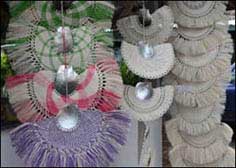 I first saw this weaving at Punanga Nui Market, the Saturday market, where one stall had numerous hats and fans woven with these fine palm strands. Many of the hats and fans were woven in coloured patterns and all were made with very fine strips.
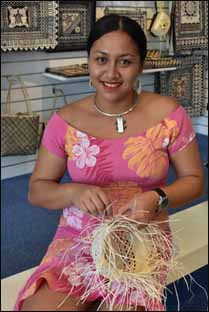 I then visited the shop Pacific Weave, where weaver Nanave Taime was weaving a basket with fine white strips. I wondered what the material was and how she managed to get it so white. Nanave was very happy to share her knowledge, and told me me that the material was boiled palm leaf. I knew that boiling NZ flax, the usual material I weave with, doesn’t whiten it to this extent, so I was interested to try this process for myself. Later that day I tried boiling both dry and green palm leaf but this didn’t make any difference to the colour of the leaf.
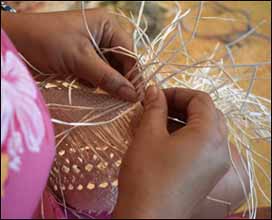 Out and about the next day, I discovered Tarani Crafts and Pearls in downtown Avarua, just past the roundabout heading towards Muri beach, and had an interesting discussion with Tarani Napa, the owner, who is very knowledgeable about traditional weaving. Tarani also has an outlet at the Saturday market.
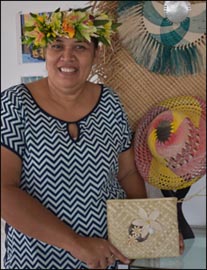 Tarani explained that the white material is part of the new leaf, or rito, of the coconut tree before it becomes green. The new leaf is peeled apart into two different types of strands. The outer fibre is coarser and creamy light fawn and the inner fibre, which is lighter, is boiled to make it white. The strips are very thin and there’s a lot of work involved in getting enough strips to weave with. It’s mostly older weavers from the outer islands — which are covered in coconut palms and a good source for rito — who weave hats.
As I saw some evidence of what I think are earlier types of weaving, such as basic market baskets and fans, and was interested in discovering how the weaving style had changed over time to a more intricate and delicate style. I wonder if this is partly due to the influence of missionaries, as the white hats and fans are often worn for church-going. I searched in the Rarotongan library and museum for information about this but found nothing. If anyone has any more information on this change of style I’d be very interested to hear about it.
© Ali Brown 2018.
Scroll down to leave a new comment or view recent comments.
Also, check out earlier comments received on this blog post when it was hosted on my original website.
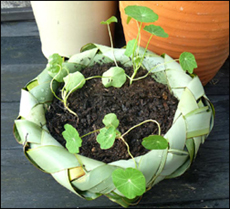 Many people enjoy creating gifts to give to friends, family, colleagues, and strangers, rather than purchasing gifts. A gift of flax flowers as a thank you, flax containers holding home-made preserves, a little flax kete to hold a piece of jewellery, or a shredded flax tie on a parcel are all received with appreciation, from my experience.
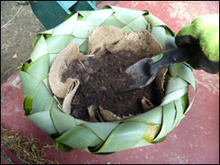 Recently I wove a waikawa to hold some nasturtium seedlings as a gift for a fortieth birthday. The basket was made with 16 full leaves and woven with a square-base. The sides were woven up higher than the intended end height of the basket and then rolled down three times to make a firm rolled edge. A piece of hessian from the sewing kit was used to line the basket to hold the dirt in place. The basket was then filled with potting mix and the seedlings planted.
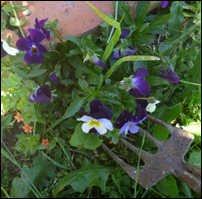 Although I used bought seedlings and potting mix, for people looking for gifts of little cost, this gift could be made at no cost, apart from your time, by using materials that are commonly found in people’s homes. The flax to weave the basket is usually a free resource, the material to line the basket can be any natural material, that could be an old unwanted garment or towel and the seedlings could be found in any home garden. Vegetable seedlings, cacti or self-sown annuals can be easily transplanted.
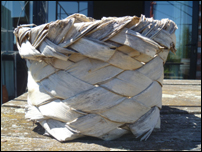 Planters woven from flax don’t stay in perfect condition when left outside. The flax will fade and bleach and parts will discolour as can be seen in this pot illustrated here, which has been outside for two seasons. The flax can also split and the weaving may unravel as it weathers. This container has also been squashed down which accounts for the wonky shape.
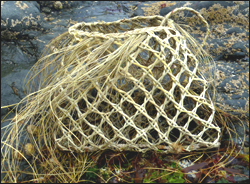 Eighteen people, coming from Okains Bay, Decanter Bay, Charteris Bay, Pines Beach, Loburn and Havelock as well as Christchurch, took part in our charity flax weaving workshop last Sunday. As usual for a workshop, there were beginners and experienced weavers attending, which is a great mix as experiences are shared and people help each other. Most people wove a two-cornered basket or kete and a couple of people tried their hand at the open-weave basket made with the kupenga or fishing net weave illustrated here. Later in the day people had time to make large containers.
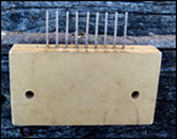 There were three different types of splitting tools in use in the workshop, apart from awls and fingernails! Sharon’s splitting tools, which were originally used for shearing sheep, had been modified with the addition of a paua-inlaid wooden handle.
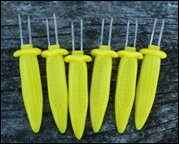 My splitting tools were made by my husband Rob using bodkins inserted into blocks of wood at equal distances. Kay’s were very original, being made from corn cob holders. Kay adjusts the distance between the prongs depending on the width of strips she requires.
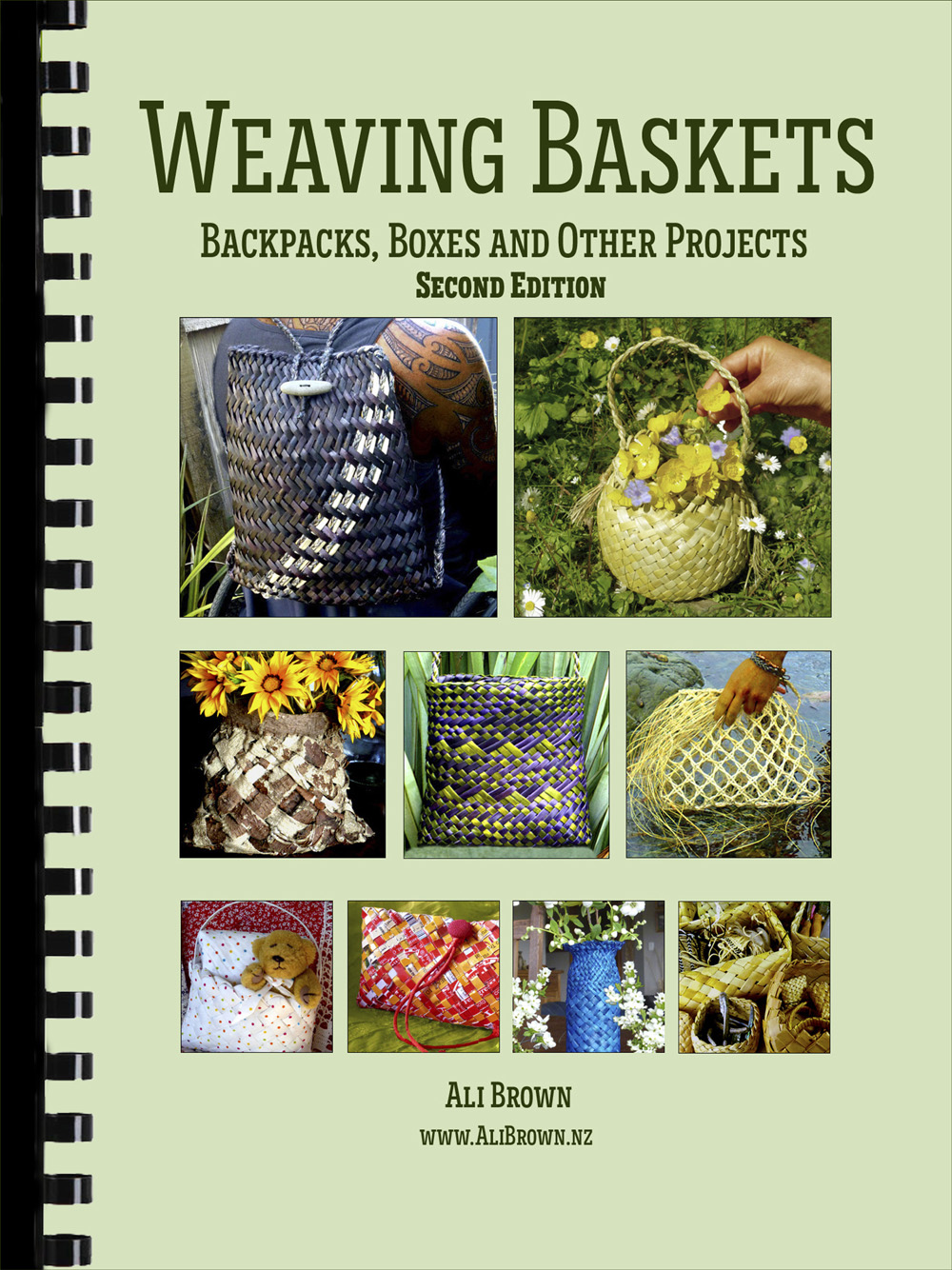 The book I’ve been writing, Weaving Baskets, Backpacks, Boxes and Other Projects, (second edition) is now ready for sale. This book covers a comprehensive range of basket-making, starting from instructions for a simple woven folded-over basket to complex patterned baskets and backpacks, as well as boxes, platters, trays, vases and pots. Each project has illustrated instructions and colour photos that show step-by-step instructions for weaving, using diagonal weaving. Over 70 different techniques and methods used in basket-making are included.
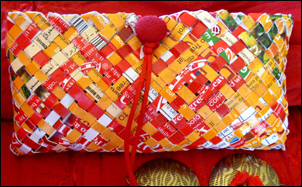 Most of the samples in the book are woven with New Zealand flax but any natural or manufactured material that can be made into long thin strips can be used, including palm leaves, strapping, bark and paper, like the basket illustrated here which is made with strips of packaging.
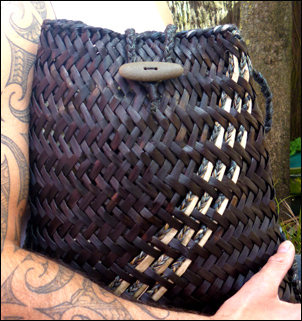 The book has instructions for traditional Māori weaving techniques such as the ones used to weave the backpack with the stone toggle illustrated here. As well as instructions for weaving backpacks, several different ways of weaving larger baskets are described in the book, including starting at the base with a plait, starting at the top with a plait and starting in the middle with a cylinder.
 More modern weaving ideas are also included in the book. The rounded-shaped basket illustrated here is reminiscent of other traditional styles of baskets, such as those seen in UK, Europe and USA. Instructions for making different types of basket handles, like the twisted one on this basket, are also included. Other projects give instructions for weaving more contemporary items like vases and pots, as well as serving platters and boxes.
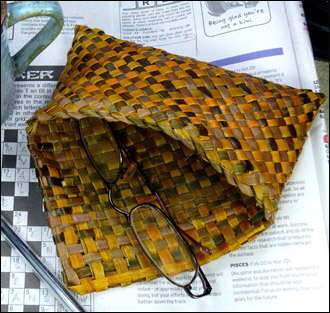 The book has new techniques to be learned in each project and so is also suitable for a course book as well as for individual weavers and groups. More illustrations from the book are shown on
 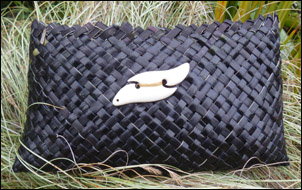 The book can be purchased directly from me through my
 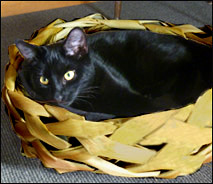 In Māori tradition, the first piece of flax weaving a beginner completes is given away and the giving of flax gifts extends this tradition. Weaving flax gifts can be both satisfying and fun and makes for both economical and very acceptable gifts. There are all sorts gifts that can be made with flax and this includes gifts for pets as well as people. A round basket, made using the technique of weaving a large container, which is explained and illustrated in my book
 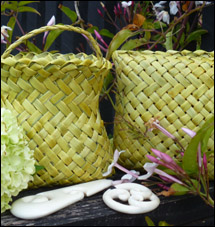 Flaxworks can also be used instead of wrapping paper as the container for a gift. When two of my long-standing work colleagues resigned, bone carvings from master carver
 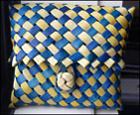 Flaxwork gifts are regularly used to represent the relationship between two organisations or groups of people. The agency where I work has a close working relationship with a Māori social service agency and to represent the two baskets of knowledge which each organisation brings to the partnership, I wove two little ketes and joined them together. These were gifted to the other organisation, the staff and clients acknowledged the representation and were delighted to accept the gift. The ketes are held together with a flax strip looped around a small flax button.
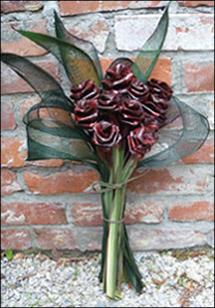 Flax flower bouquets make a welcome thank-you gift for a guest speaker. These flowers are woven with variegated flax and dyed red. The whiter parts of the variegated flax dyed a different red from the greener parts, which give the flowers an interesting twist. These soft multi-coloured flax varieties aren’t usually used for weaving but their softness is fine for flowers and makes them easier to weave. Information about netted flax is on my page
 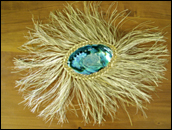 A paua-shell kete can be very acceptable as a gift, particularly for people from other countries. It gives the recipient a taste of the culture of New Zealand, and always seems to be well received. I’ve made paua kete in several different styles, including one with a long fringe illustrated here, and a more wrapped-around version shown in my blog post
 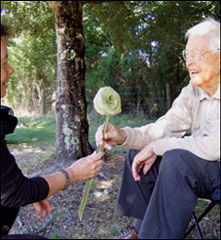 However the tradition of giving the first piece of weaving away originated, it reflects the fact that weaving flax is not just a personal accomplishment but relies on a whole body of knowledge, experience and tradition that has been passed down through many generations and is part of the culture of giving. This photo shows a flax flower symbolising the love between two people, in this case a father and daughter — and as it’s one of the last photos I have of my late father, it holds a special meaning for me.
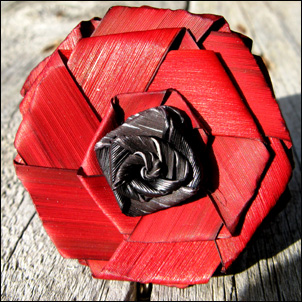 Each year in New Zealand, as ANZAC day draws near, red poppies, a world-wide symbol of remembrance for people who have lost their lives in war, start to appear. Poppies are usually made from paper or cloth, and lately knitted poppies have become popular. A few years ago I wove a poppy from flax for a friend and he told me recently that he continues to wear it every ANZAC Day. I have regularly been asked about weaving flax poppies, so here is how I made the one for him.
 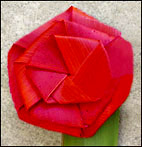 I used dyed flax, one leaf of red and one leaf of black. The red leaf is woven into a Chrysanthemum, instructions for which are on pages 5-8 in my book
 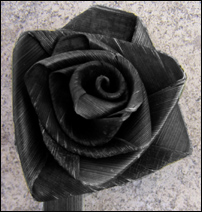 The black leaf is woven into an small English Rose, instructions for which are on pages 27-31 in the same book. The stem of the rose is pushed through the centre of the chrysanthemum, tied around the chrysanthemum and the ends of both flowers cut off, taking care to ensure that they are not cut off so close to the flowers that they unravel. A brooch backing or safety pin is stuck to the back with tape so the poppy can be worn on clothing.
 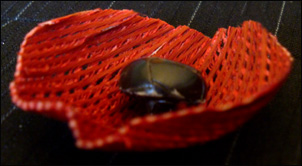 A simple flax poppy can also be made with netted flax that has been dyed red. Cut a circle out of red netted flax and moisten the flax. Push it into a round container that is smaller in diameter than the round of flax is, so that it will curve the edges up to make the shape resemble poppy petals. Take the round of flax out of the container once it’s dry and attach a black button, preferably one with a shank, for the centre of the poppy. The button can be sewn onto the netted flax and a fastening attached onto the back.
 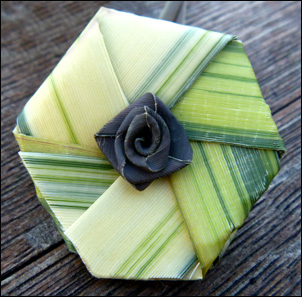 If you would like to weave a poppy without having to dye the flax, you could weave a white one with the leaf from a white hybrid flax, although greenish stripes may show where the back of the flax leaf is uppermost during the folding process. The central rose in the poppy illustrated here is made with brownish/black flax. The white poppy, which used to be seen by some as unpatriotic, and perhaps still is, conveys not only remembrance but also the hope for an end to all wars.
 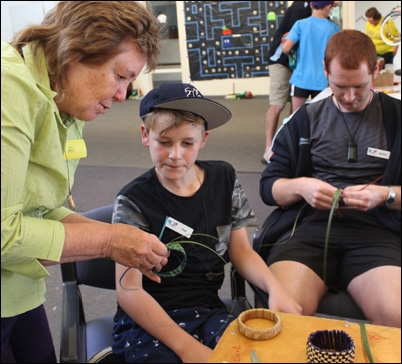 January this year I tutored two flax weaving workshops at Camp Quality, which is a summer camp for children living with cancer.
 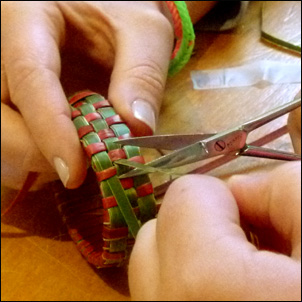 I prepared the base for each wristband from the flax leaves and split the long length of the strip used to make the band into three even-width strips and the children chose the colour of their weaving strip. They wove the pattern by weaving the coloured weaver over and under the three strips all the way around which results in a checkerboard pattern as shown here.
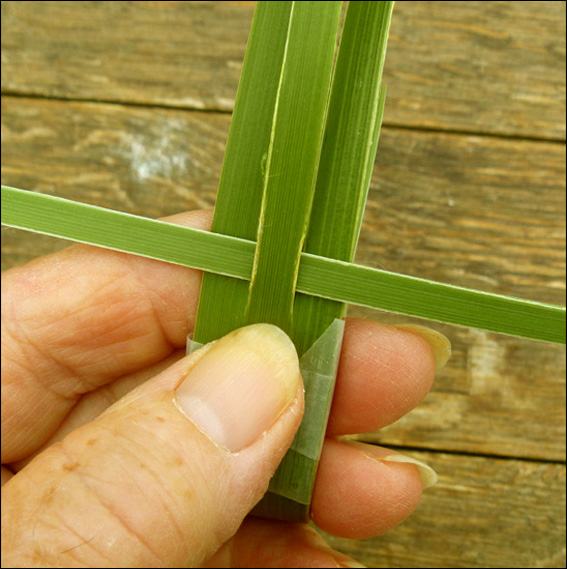 Some children tried weaving more complicated patterns. One used two different coloured strips as the weavers, alternating them at each turn. A couple of others were keen to try the
 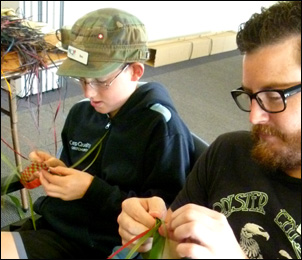 At camp each child has a twenty-four hour buddy who gives them one-on-one support and the wristbands turned out to be a popular choice for the buddies too, a couple of them returning to make a second one. Most people wove the first wristband for themselves and then went on to weave others for family and friends.
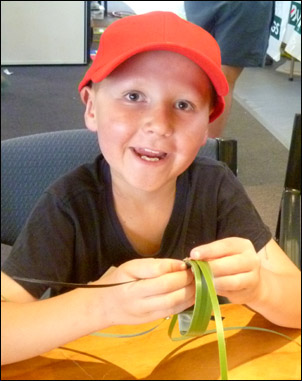 I’ve found from past workshops that weaving wristbands is a popular project and can be woven by children from about five years upwards. The younger ones may need assistance but do tend to get into the rhythm of weaving after a while. This workshop proved how suitable wristbands continue to be for a children’s weaving workshop, as well as being of interest to all ages.
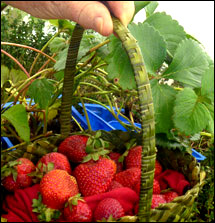 The same technique used to weave a pattern on wristbands can also be used to weave over the base of a handle for a basket. For example, the handle illustrated here has a
 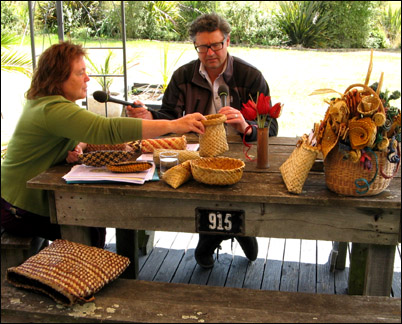 Earlier this year, Cosmo Kentish-Barnes of Country Life interviewed me about flax weaving and the interview was aired on Country Life on 11 and 12 July. (The interview can still be played
 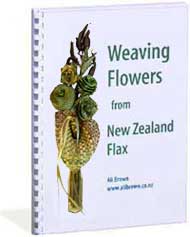 In preparation for the interview I got together some weaving we could talk about as well as my book Weaving Flowers from New Zealand Flax. Cosmo asked questions about the book, the weaving, how I became interested in weaving, how long I’d been weaving for and so on. As I’m working hard to complete my next book, on how to weave baskets, I also chattered on about that.
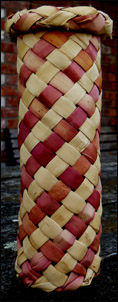 This is the pot with the spiral pattern that I discussed. The pot is started with a plait at the base and the coloured strips are added in the same sequence that they are for a diagonally striped basket i.e. two crimson strips and then two natural-coloured strips alternately on each side. I then wove the sides up and rolled down the top to give the pot a strong rim. As this was an experiment to see what effect the spiral pattern would have on a pot, I used quite wide strips. I think the result is pleasing and would look even better if the pot is made with thinner strips. The black and white kete with the whitebait pattern that I talked about in the interview is illustrated on the
 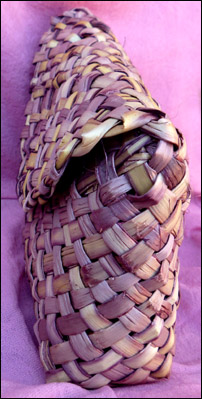 One of the pieces of weaving that doesn’t feature in the programme but took Cosmo’s attention was the soft, muted colour of this pink bag, which is photographed side-on. I mentioned that I’ve sometimes played around with natural dyes as well as chemical dyes, and the bag was an experiment in using red wine as a dye. In the event, this bag used up six bottles of red wine, which he felt was rather a rather a waste of good wine and, in retrospect, I have to agree. I just hadn’t realised how many bottles it would take. At some point, I might try dyeing flax with the red wine skins left over from wine making to see how they turn out.
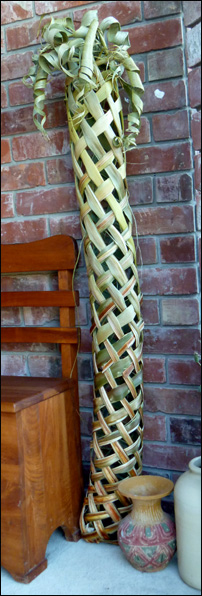 Another piece of weaving we talked about is this long sculptural experiment, woven with the technique that’s used for weaving a large container or waikawa. I started with six long leaves of flax that I pulled apart right down to the end of the butt, ensuring that the two sides were still joined together at the butt. I then wove the sides up as far as I could go with the lengths of the leaves, and wound the ends of the leaves that were long enough around a cylinder so they curled as they dried. Once dry I unwound them from the cylinders and they hang down like curls on a head. This was a fun piece to make although it took quite a lot longer than I expected and was a bit awkward to weave as it got longer. It’s been much appreciated by my cats, who loved climbing up it when they were kittens.
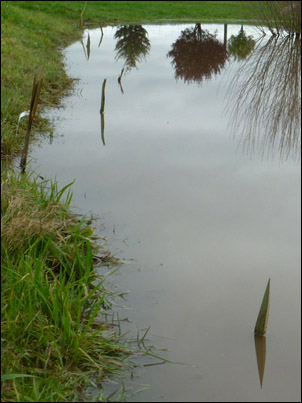 We also talked about the types of flaxes that can be used for weaving and Cosmo wondered if the ones he saw around the garden could all be used. The flaxes that were planted here when I moved here just over two years ago are mostly ornamental and generally only good for weaving flowers. I explained that, since I moved here, I’ve planted a number of weaving flaxes from the
 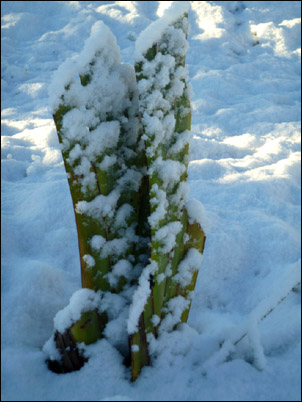 The divisions I planted are now growing well around a winter pond, although they are subject to very dry conditions in summer and very wet conditions in winter. In the middle of a wet winter some of them can be completely covered apart from a little tip poking up, but the water recedes reasonably quickly over a few days, and their occasional dunking doesn’t seem to have affected their growth. When first planted in the autumn of 2012 the divisions were small stumps with cut-off leaves. They were covered in snow that winter and covered again the next winter but survived these conditions well.
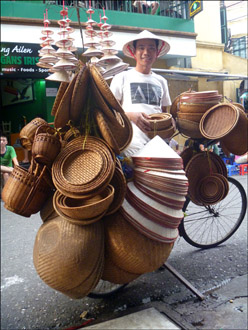 I spent some time in Vietnam recently enjoying the company of my eldest son and his partner as they cycle from New Zealand to Ireland. One of the ways I gain inspiration for my own weaving is by picking up ideas from other cultures, so I was particularly interested in the wide range of baskets found in everyday life in Vietnam. Bamboo, cane and rattan are the main materials used and although these have a stronger structure than NZ flax, some of the weaving ideas could be used with flax.
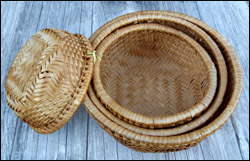 A set of baskets that I purchased from this street vendor are typical of one of the commonest styles of baskets in Vietnam. The baskets appear to be made by weaving a square with a loose twill weave, with four or even five strips being crossed in one weave, then filling the sides with smaller strips pulled up into a semicircle, and then drawing the corners of the square together to make the bowl shape. Unique
 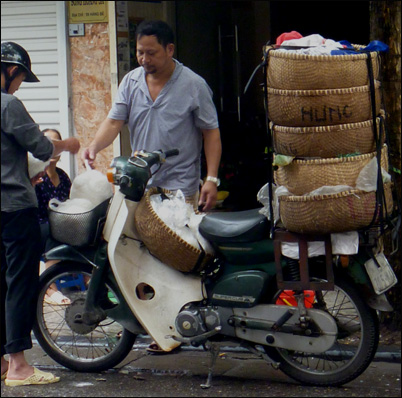 Larger versions of the baskets I bought are often tied several baskets high on the carrier of a bike or motor scooter for transporting goods. This noodle seller piled rice noodles into large baskets, covered the wobbly piles of noodles with plastic and then tied them on his bike for delivery. He was a popular seller in the early morning as noodles are often eaten for breakfast, with rice being eaten later in the day.
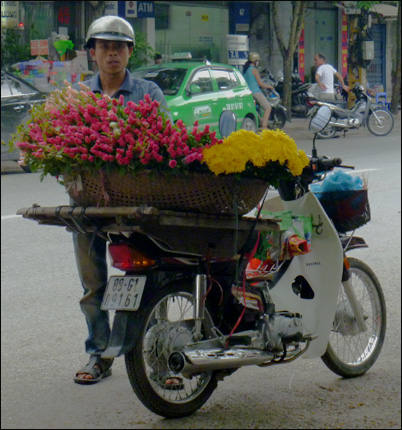 Other street vendors, selling everything from fruit and vegetables, to brooms, clothes, ceramics and cooked food, use a flatter style of basket carried on the back of a bike to display their wares. Bunches of little rose buds and other flowers are displayed to advantage on the large flat basket of this vendor. Others used the large flat baskets to hold little charcoal cooking stoves that could easily be set up anywhere for cooking food to sell. The large flax container, or waikawa, woven with whole flax leaves, can be used in a similar way to display wares, especially if the sides of the basket are kept low. (My book Weaving a Large Container from New Zealand Flax has instructions for this type of basket and can be purchased directly from me for $15, which includes postage and packaging, using direct credit as outlined on my
 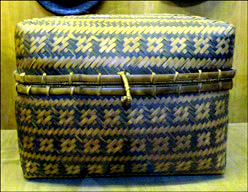 While in Hanoi I visited the Museum of Ethnology which presents the domestic culture of six of the major groups that comprise the Vietnam population. This attractive woven box caught my eye. It is has a diagonal weave and incorporates a pattern that is reminiscent of patterns used in traditional flax weaving.
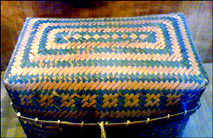 Although it is woven from rattan, this style of box container could be woven in flax. I particularly like the way the pattern is worked on the top of the container. It appears to have been worked by weaving one quarter of the square first and then weaving the other three sides of the square around to meet back at the first one.
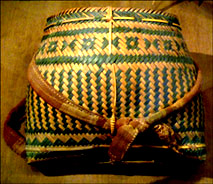 Again, the patterning on this basket, with its vertical and horizontal twills, could be worked as the pattern when weaving flax. In fact it’s quite likely that it’s already been used, not as a copy, but independently, as the patterns I saw in the museum are very similar to those used in traditional Maori weaving. I particularly like the way this basket is shaped.
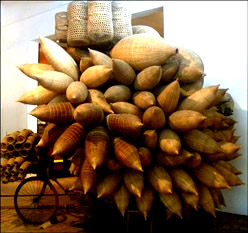 I saw a variety of other types of weaving, one of the most spectacular being these fish traps stacked high onto a vendor’s bicycle. The traps, woven with thin strips of bamboo, are similar to the traditional Maori traps woven from manuka stems and supplejack vines.
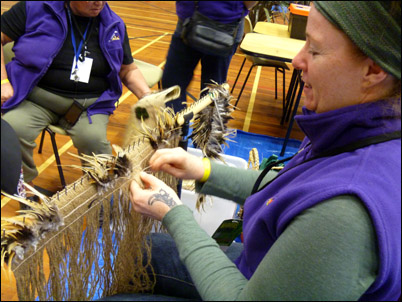 Jute, cotton and raffia aren’t traditionally used in Māāri weaving but these materials were being used by Lisa Smith from Ahipara to weave a cloak for one of her sons. Lisa used jute for the warp threads and a finer cotton for twining the weft threads. Black tags made from raffia found in a $2 shop were added as the twining progressed and decorative panels were made with the addition of coloured tail feathers from a rooster. Lisa used a frame to support the weaving and added the feathers upside down so that they didn’t get in the way of the weaving. Being a busy mum, Lisa has overcome the time consuming task of preparing materials with her imaginative use of bought threads.
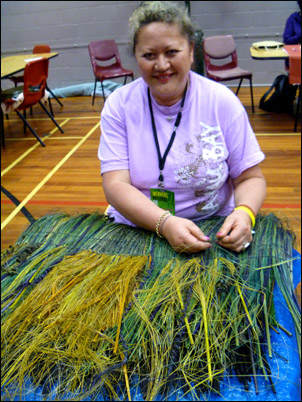 Paretio Ruha from Waihau Bay chose the legend of the creation of pīngao as the inspiration for the cloak, or rapaki, she was weaving as part of her studies of Māori art at Te Wananga o Aotearoa Rahui Pokeka in Huntly. In the legend, Tangaroa, God of the sea, was angry with his brother Tane, God of the Forest, for separating their parents Papatuanuku and Ranginui. To appease Tangaroa, Tane offered him his eyebrows. Tangaroa became angry at this offer and threw the eyebrows back up onto the beach where they sprouted and grow today as
 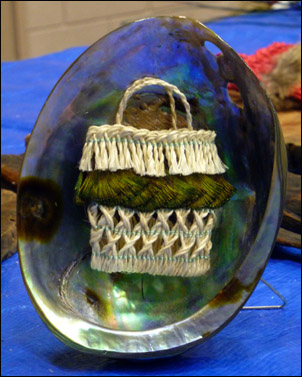 Bev Vellenoweth from Ōpotiki specialises in weaving with fine fibre, or muka, creating tiny baskets like the one shown here inside a paua shell. She uses fine jewellery wire for a twining thread to hold the fibre together, and to give structure and shape to the article she is making. Bev’s entry in the fashion show featured a dress with a fine fibre bodice and a skirt made with thin flax cylinders dyed a pretty soft green. Bev uses both naturally coloured and dyed fibre to make her little baskets which she exhibits widely and has won a number of awards for.
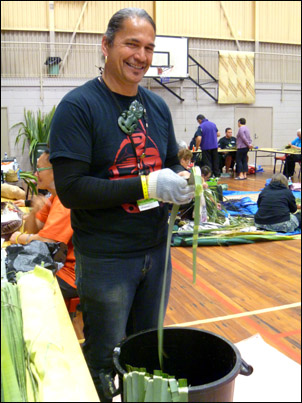 Karl Leonard is an experienced skirt, or piupiu, maker and well used to preparing flax strips for these garments. Using a long ruler marked at different lengths as a guide, he cuts the flax halfway through on the back of the strips at each guide mark. Next he separates the green flesh of the leaf from the fibre in between the cut parts on the leaf. Karl advises that when preparing strips for patterning in this way, it’s important to keep the leaves damp as the fleshy part strips off much easier when the leaves are moist. To complete the preparation for piupiu making, the strips are boiled and hung up to dry where they curl into cylinders. The strips are then ready to be braided onto the waistband and dyed. When flax prepared in this way is dyed, the dye adheres to the fibre and not to the unscraped flax, making dyed and undyed blocks on the cylindrical strips which create the pattern.
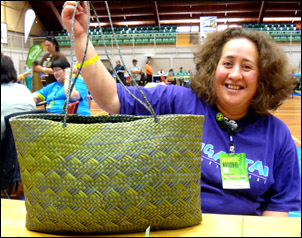 It was good to meet Felicity Champion at the gathering as we have corresponded over the years and Felicity has promoted my book to her weaving students. Felicity brought along a basket that she had woven using two different greens to make the pattern. Using colour in this way is very attractive and results in a subtle, natural blend of colours that I find very pleasing to the eye. Felicity’s basket caught many people’s admiring attention as they passed by.
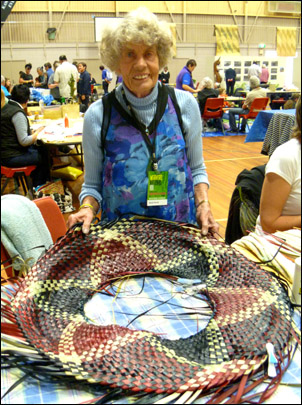 Marie Flavell’s choice of weaving was a circular piece which she started and completed over the weekend. She started with a plait, adding in a number of red, black and natural coloured strips in a particular sequence and, as she wove, a pleasing flower-like pattern emerged. To make a circular piece like this, add the strips to the plait two or four at a time, overlapping them as they are added. This allows for the weaving to be curled around. Marie mentioned that her favourite weaving flax is
 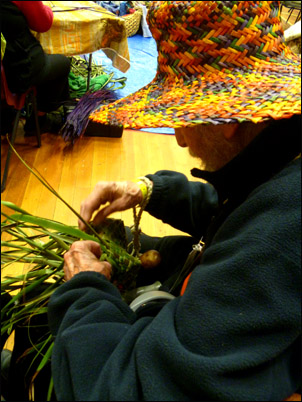 Chris Bradshaw from Matata, a guest of honour at the gathering, has specialised in weaving hats, or pōtae and it was interesting to see the different style of hat that Chris wore each day. The hat pictured here is started at the crown using a method that is often seen for the start of the base of a container with pointed feet, in weaving from Asia. Another of Chris’s hats was woven with pīngao leaves, the fluted ends of the pīngao leaf, where it is pulled from the plant, being used as a decorative feature at the edge of the brim. I enjoyed seeing the variety of hats that Chris had woven and plan to make a hat for myself over the Christmas break.